Why Central Bank Buying Tells a Different Story This Quarter
Maayo 31, 2026
Weli kuma jiro Af-Soomaali. Waxaa la tusayaa nuqulka Ingiriisiga.

Central-bank demand remains one of the strongest structural arguments behind gold.
The first-quarter data support that view in aggregate. Net official-sector demand was estimated at roughly 244 tonnes, slightly above the same period last year and stronger than the previous quarter.
But the aggregate figure conceals a much more uneven picture.
Some reserve managers continued accumulating aggressively. Others reduced their holdings substantially. And among the institutions that were buying, a relatively small number accounted for a large share of the identifiable purchases.
That makes the composition of official-sector activity more useful than the total alone.
The important questions are not simply whether central banks are buying gold, but which institutions are buying, how concentrated those purchases are, whether the behaviour is persistent, and why other reserve managers are selling at the same time.
Official-sector flows were unusually two-sided
The largest identified buyer in the first quarter was Poland, which added roughly 31 tonnes.
Uzbekistan followed with approximately 25 tonnes, while Kazakhstan added around 12 tonnes. China increased its reported holdings by roughly 7 tonnes, and the Czech Republic and Malaysia each added about 5 tonnes.
Smaller purchases were reported across a wider group that included Guatemala, Cambodia, Indonesia, Serbia and the UAE.
At the same time, several reserve managers moved sharply in the opposite direction.
Turkey's official-sector holdings declined by roughly 70 tonnes over the quarter.
The State Oil Fund of Azerbaijan reduced its holdings by approximately 22 tonnes, while Russia reported a reduction of a similar size.
That produces a very different picture from simply looking at the Q1 net-demand estimate.
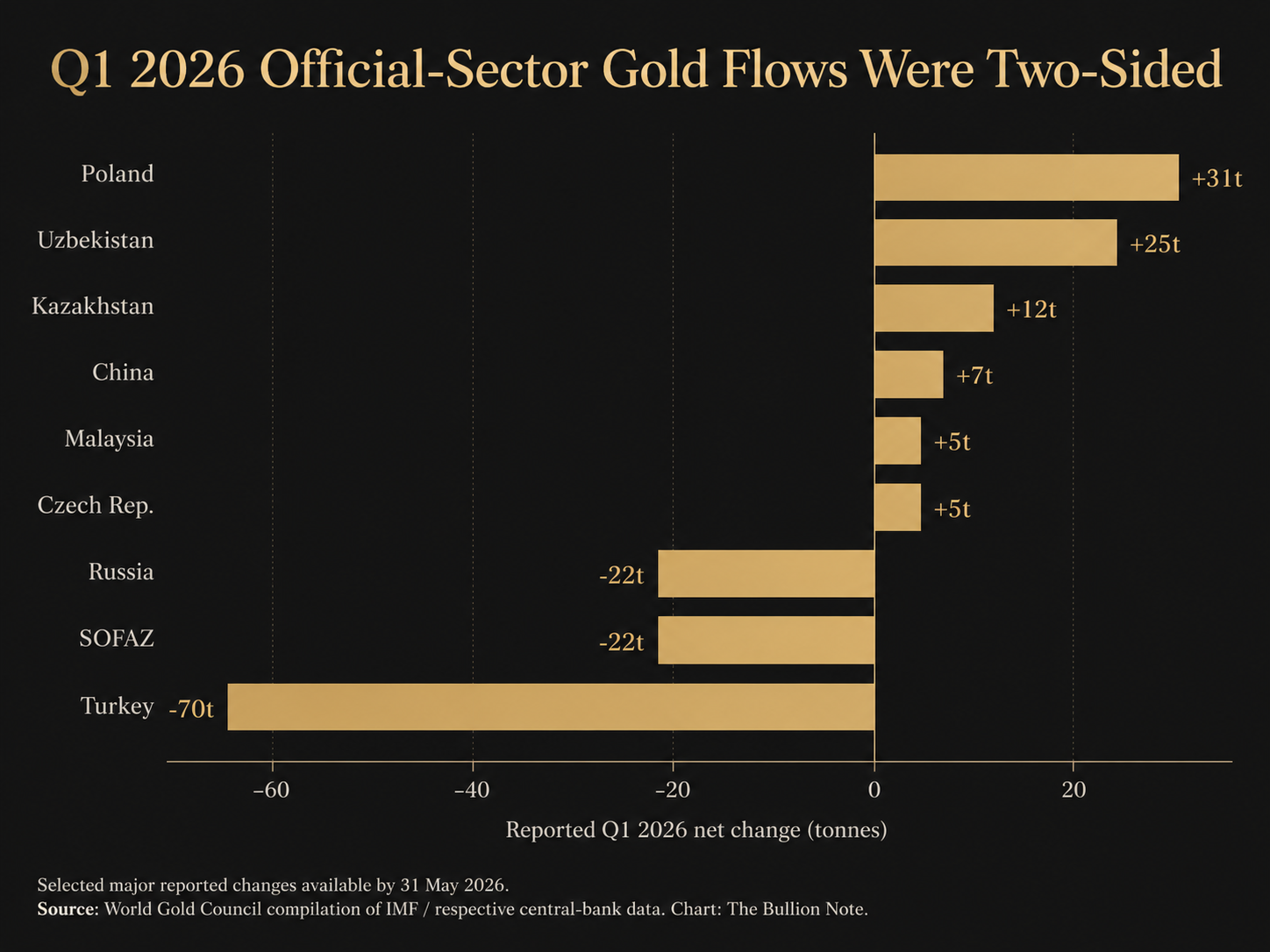
Source: World Gold Council compilation of IMF and respective central-bank data. Selected reported Q1 changes. Chart: The Bullion Note.
The market was not being supported by a uniform global accumulation programme.
It was being shaped by large purchases from some reserve managers and significant reductions from others.
Netting those flows together is useful for measuring total demand.
It is less useful for understanding what central banks are actually doing.
The buyers were broad geographically, but concentrated by size
Official-sector purchases were geographically diverse.
Europe, Central Asia, East Asia, Southeast Asia, Latin America and the Middle East all contained identified buyers.
But the tonnage was not evenly distributed.
Among the identified purchases, Poland and Uzbekistan alone represented roughly 60% of the buying shown in the available country-level data.
That is an important distinction.
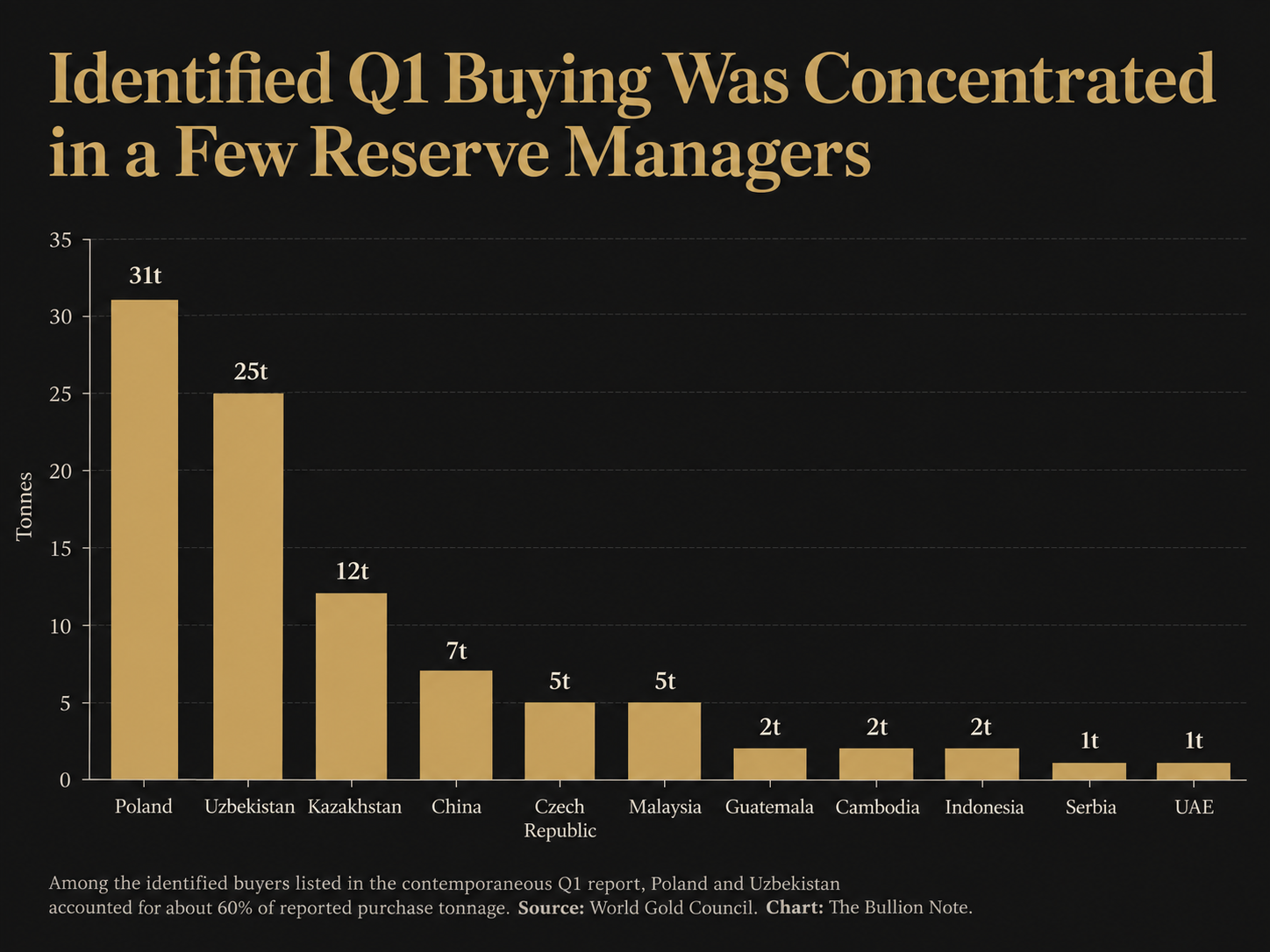
Source: World Gold Council. Calculation and chart: The Bullion Note.
A 30-tonne increase from one institution and thirty separate 1-tonne increases have the same effect on the aggregate total.
They do not contain the same information.
The first tells us that a particular reserve manager has made a significant allocation decision.
The second would suggest that a broader change is taking place across the official sector.
For gold, both can support demand.
But for judging whether central-bank accumulation is becoming more deeply embedded across reserve portfolios, breadth and persistence matter as much as tonnage.
Poland is important because of scale
Poland was the dominant identified buyer during the quarter.
Its roughly 31-tonne increase stands well above most other reported additions and continues a broader pattern of substantial gold accumulation.
That makes Poland important for the immediate demand picture.
But it also creates concentration risk in the interpretation.
If one or two large reserve managers account for a significant proportion of identifiable buying, a slowdown from those institutions can change the quarterly picture quickly even if the broader strategic case for gold remains intact.
The next question is therefore not simply whether Poland bought heavily in Q1.
It is whether the pace remains persistent.
A recurring 20- or 30-tonne buyer matters very differently from an institution that makes a single large allocation and then disappears from the market.
China matters for a different reason
China's reported Q1 purchases were much smaller than Poland's.
That does not make them less informative.
The People's Bank of China added approximately 7 tonnes during the quarter, taking reported holdings to around 2,313 tonnes.
The more important feature is the sequence.
China continued adding gold across successive months despite substantial changes in price, monetary expectations and global risk sentiment.
That persistence tells us something the quarterly tonnage does not.
An institution that repeatedly increases its allocation through different market conditions appears to be making a more structural reserve decision.
The size of each monthly purchase may be modest.
The consistency is the signal.
This is why central-bank demand should not be ranked purely by tonnes purchased in a single quarter.
Scale tells us how much metal is being absorbed. Persistence tells us more about why.
Turkey shows the other side of reserve ownership
The most interesting official-sector activity this quarter may actually have come from a seller.
Turkey's holdings fell by roughly 70 tonnes, with much of the reduction concentrated in March.
Read mechanically, that appears negative for gold.
But the underlying transactions complicate that interpretation.
Turkey also utilised a substantial amount of gold through swaps designed to obtain foreign-exchange liquidity during a period of intense external pressure.
That matters because a reserve asset is not valuable only because it can be accumulated.
It is valuable because it can be used.
Gold held on a central-bank balance sheet can provide diversification during normal conditions and liquidity during periods of stress.
Those functions are not contradictory.
They are complementary.
Turkey therefore raises a more interesting question than whether a large central-bank sale is "bullish" or "bearish."
The question is what the sale tells us about gold's function inside the reserve portfolio.
In this case, the drawdown suggests that gold was sufficiently liquid and useful to be mobilised when foreign-exchange needs intensified.
Buying and selling can come from the same reserve logic
This is where the quarter becomes more interesting.
One group of central banks was increasing its gold allocation.
Another was drawing on gold to meet liquidity requirements.
Both behaviours can be consistent with treating gold as an important reserve asset.
A central bank that buys gold for diversification does not necessarily intend never to touch it again.
If external conditions deteriorate, the ability to mobilise those reserves is part of their purpose.
That means central-bank selling requires context.
A sale caused by a strategic decision to reduce gold's role in reserves is very different from a sale or swap used to obtain temporary liquidity during a balance-of-payments or currency shock.
The transaction looks similar in the aggregate data.
The economic meaning is different.
The reported total also contains uncertainty
There is another reason to treat the aggregate Q1 estimate carefully.
Not every official-sector transaction is disclosed immediately.
Central banks report reserves on different schedules, and some provide far more detail than others.
The quarterly estimate therefore combines identifiable reported activity with estimates for activity that has not yet been fully attributed.
This creates a gap between two different measures:
the amount of official-sector demand estimated to have occurred;
and the amount that can be linked to specific reserve managers.
That distinction is important.
Country-level data tell us something about the behaviour of identifiable institutions.
The aggregate estimate attempts to capture the whole official sector, including activity that may only become visible later.
For analysis, both are useful.
They should not be treated as the same thing.
A better framework for central-bank demand
Instead of asking only how many tonnes central banks bought, the official-sector signal can be broken into four dimensions.
Breadth asks how many institutions are participating.
Concentration asks how dependent the total is on the largest buyers.
Persistence asks whether buying continues across multiple months and market regimes.
Purpose asks whether the activity reflects strategic accumulation, portfolio rebalancing or liquidity needs.
That framework produces a much more useful picture than the aggregate total alone.
A quarter of strong buying distributed across many recurring buyers would represent a powerful structural signal.
A quarter with similar total demand but dominated by one or two institutions would still support the market, but it would say less about broad reserve behaviour.
Likewise, large selling does not necessarily indicate that confidence in gold is weakening if the metal is being mobilised for liquidity.
The direction of the flow matters.
The reason for the flow matters more.
What matters next
Poland remains the largest identifiable buyer to watch.
If purchases continue at a similar pace, its contribution to official-sector demand will remain significant.
If they slow sharply, the concentration of Q1 buying becomes more important.
China should be monitored for persistence rather than scale. Continued monthly additions would extend an accumulation pattern that has already survived very different market conditions.
Uzbekistan and Kazakhstan remain useful indicators of whether Central Asian demand continues to provide a recurring source of official-sector buying.
Turkey is the key case on the other side.
If its holdings stabilise or rebuild after the March liquidity episode, the reduction will increasingly look like tactical reserve mobilisation.
Continued large reductions would imply something different.
The final variable is breadth.
The strongest structural signal would not necessarily be another record purchase from Poland or China.
It would be more reserve managers joining them.
The takeaway
Central banks continue to matter enormously for gold.
But the Q1 estimate of roughly 244 tonnes should be treated as a starting point rather than the conclusion.
Underneath the aggregate figure, official-sector behaviour was unusually diverse.
Poland and Uzbekistan accounted for a large share of identifiable buying.
China continued a smaller but persistent accumulation programme.
Turkey mobilised a substantial quantity of gold during a period of external pressure.
Russia and SOFAZ also reduced holdings.
The official sector was therefore doing two things at once:
accumulating gold and using gold.
For the gold market, the strongest signal is not simply a large quarterly purchase total.
It is broad, persistent accumulation from multiple reserve managers.
And when large sales occur, the more useful question is not simply how many tonnes left the balance sheet.
It is why the gold was sold in the first place.
That is where the composition of central-bank activity starts telling a much more useful story than the aggregate number alone.